I am Tianyu Wang, an undergraduate in Software Engineering at Soochow University. I will begin an M.S. in Software Engineering at Southeast University in September 2027. My interests include multimodal LLM post-training, reinforcement learning, and multi-agent systems. I am seeking internships in these areas.

📖 Educations

  • Southeast University , incoming M.S. in Software Engineering (recommended admission)
  • Soochow University , B.Eng. in Software Engineering, GPA in the top 6%

💻 Internships

Ant Group · Multimodal UI Reasoning Model Post-training

LLM Post-training / Reinforcement Learning / Distributed Training

ms-swift / SFT / GRPO / OPD / DeepSpeed / vLLM

Background: Using real Alipay user data, the project handles feedback requests. After users submit feedback and screenshots, the system interprets the UI and reasons about their situation to help troubleshoot the issue or route the feedback to the development team.

  • Post-training and alignment: Built teacher and student SFT and GRPO pipelines with a customized version of ms-swift, followed by student OPD and attention knowledge distillation. GRPO samples eight responses per question to compute group-relative advantages. In OPD, a frozen teacher supervises the student on its own sampled trajectories: reverse-KL distillation aligns output distributions, and JSD distillation of final-layer causal attention aligns where the model attends in context.
  • Distributed training and ablations: Participated in multi-GPU training, experiment replication, and result analysis for 4B and 32B models on 16 NVIDIA A100 80GB GPUs. Used DeepSpeed ZeRO sharding and gradient checkpointing to reduce memory use. GRPO and OPD used rewards for response format and answer correctness plus an overlength penalty, weighted 1.0:1.0:0.5, with dynamic sampling. Led staged ablations of SFT, GRPO, OPD, and attention distillation to isolate each stage’s contribution.
  • Data and evaluation: Cleaned internal UI data, organized evaluation sets, and evaluated models. A VLM-based automated cleaning and labeling pipeline annotated more than 570,000 examples across three task categories: element usability (232,000), information architecture (227,000), and design consistency (116,000). The 4B student gained 33.4 percentage points on an internal evaluation set; attention distillation added 2.7 points over output-only distillation. Compared with UI-TARS-7B, it scored 9.1 and 11.0 points higher on UI-Vision and OSWorld-G, respectively.

Nanjing University Reasoning and Learning (R&L) Joint Laboratory (WebAce Inc.) · Algorithm Intern

  • Contributed to a platform integrating 127 machine-learning algorithms for a research institute. Reproduced classical ML algorithms on NVIDIA hardware and adapted, modified, and retrained vision models including FairMOT on Ascend 910.
  • Contributed to the data pipeline for a Jiangsu road-debris detection system, processing about 70,000 road-scene images through video keyframe extraction, YOLO-assisted pre-annotation, and data organization.

📝 Publications & Projects

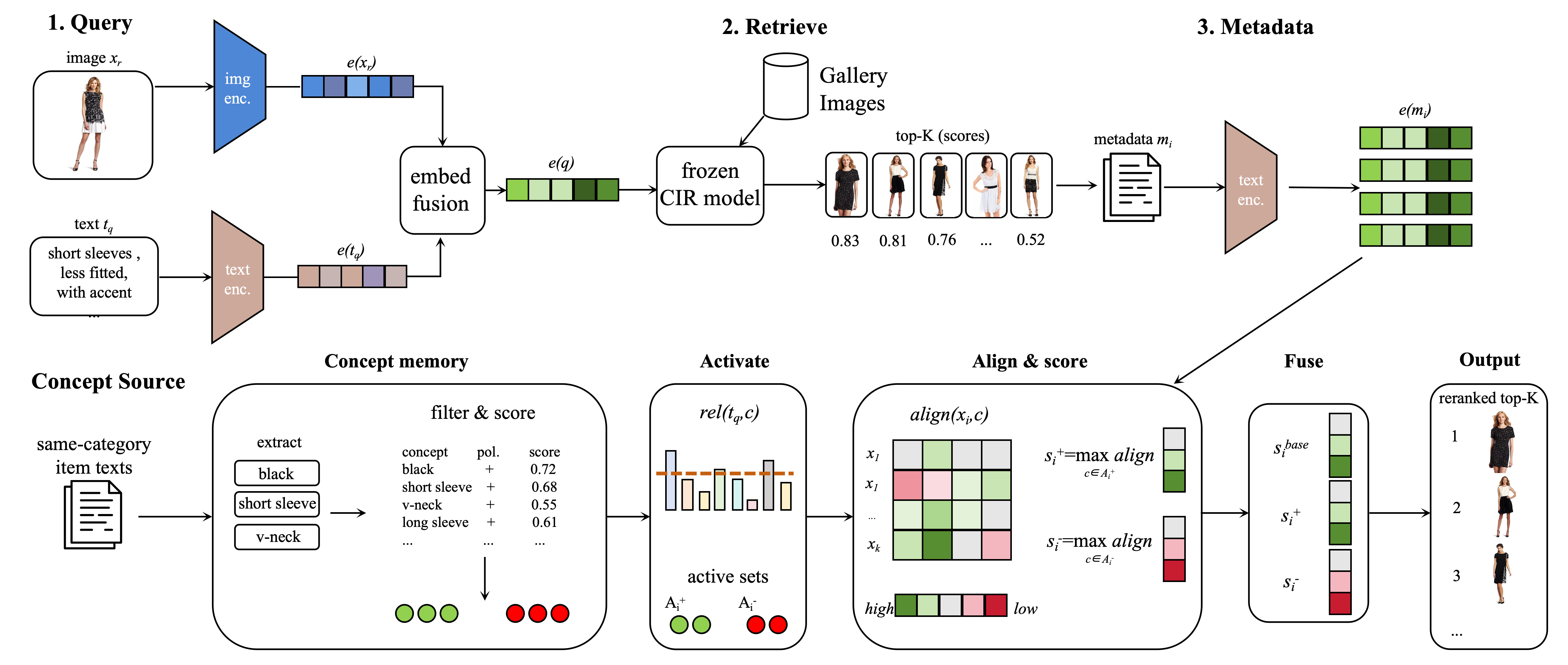
PRICAI 2026 AutoConcept pipeline for concept-guided reranking in composed image retrieval

Wang, T., & Wu, T. (2026). AutoConcept: Training-Free Concept-Guided Reranking for Metadata-Available Composed Image Retrieval. PRICAI 2026.

Proposed a training-free concept-guided reranking method for composed image retrieval (CIR). An explicit memory of positive and negative preferences supports preference-aware reranking through visual-feature filtering, relevance gating, and adaptive score interpolation.
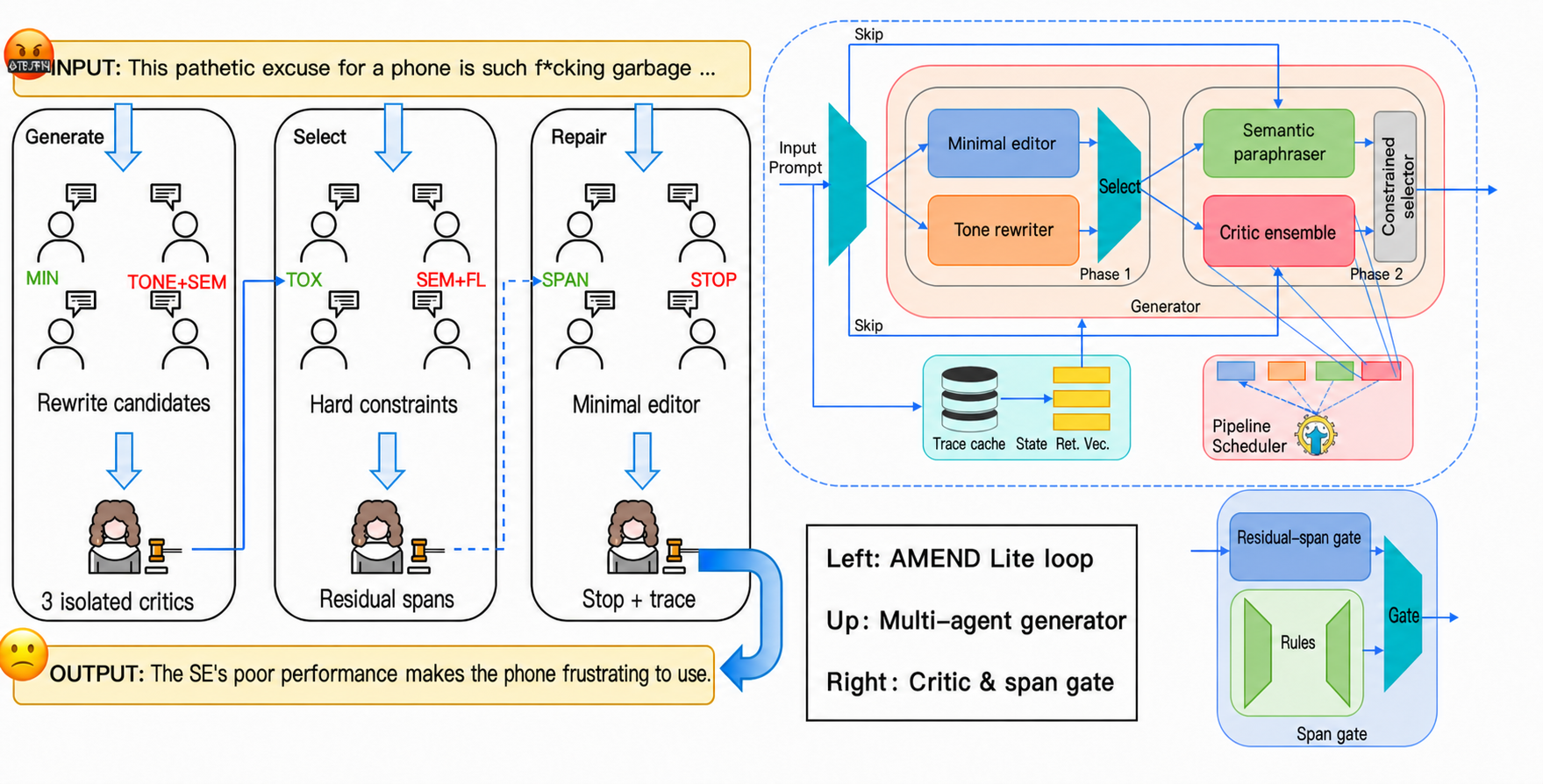
Technical report AMEND pipeline for multi-agent text detoxification and constrained selection

Wang, T. (2026). AMEND: Constraint-Guided Multi-Agent Text Detoxification with Isolated Critics. Technical report.

Designed a multi-agent, multi-critic text detoxification framework for safety alignment. Critics for toxicity, semantic preservation, fluency, and safety provide iterative feedback and rerank candidate responses, reducing harmful language while preserving meaning and generation quality.

🎖 Honors & Rewards

  • 26th China Robot and Artificial Intelligence Competition — National First Prize
  • Chinese Collegiate Computing Competition, Group Programming Ladder Tournament — National Third Prize
  • 15th Lanqiao Cup National Software and IT Competition — National Excellence Award; Jiangsu Provincial First Prize
  • Soochow University 2024 Innovation and Entrepreneurship Competition — Third Prize
  • Soochow University Academic Excellence Scholarship — Special Prize (2024–2025), First Prize (2023–2024)
  • Soochow University Innovation and Entrepreneurship Scholarship — Special Prize (2023–2024)
  • Soochow University Comprehensive Scholarship and Civic Merit Award (2024–2025)

🛠 Skills

  • LLM post-training: SFT, GRPO, OPD, reward-driven training, verl, multi-GPU training, rollouts, benchmark evaluation, and ablation studies.
  • Programming and multimodal ML: Python, C/C++, PyTorch, VLMs, GUI grounding, model migration, and visual-data pipelines; 100+ GitHub stars and 100+ followers.
  • Coursework and foundations: CS336 and CS224N; Transformers, LLM pre-training and post-training, and NLP fundamentals.
  • CSP: 370 (top 1.34%)
  • CET-6: 659